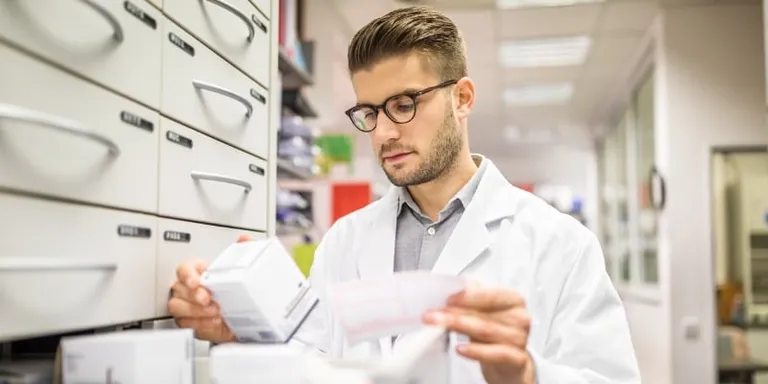
The short answer: a pharmacy assistant supports the pharmacy team with prescription intake, stock, and customer service, and can start work after a short diploma. A pharmacy technician is a regulated professional who checks and dispenses prescriptions, and needs an accredited one-to-two-year program plus registration with the Alberta College of Pharmacy. In Alberta’s 2023 wage survey, pharmacy assistants average $21.28 an hour and pharmacy technicians average $33.91 an hour.
Updated July 2026.
Outside of becoming a pharmacist, these are the two main careers in a pharmacy. Both keep a pharmacy running, but they differ in responsibility, training, regulation, and pay. Here is how to tell them apart and decide which suits you.
Pharmacy assistants in Alberta
Pharmacy assistants support pharmacists and technicians. They prepare, label, and store medications, manage inventory, handle records, and serve customers at the counter.
Education and training
Formal education is not always mandatory, but most employers prefer or require a pharmacy assistant program, and it helps you start with confidence. Programs are short: the Pharmacy Assistant Diploma at ABES College runs 26 weeks, about six months, and includes a supervised practicum. You can read more in our guide to pharmacy assistant careers in Calgary.
Day-to-day work
A typical day includes entering prescription information, counting and labelling medications, managing stock, processing insurance claims, and handling payment and customer questions.
Pay
Per ALIS (2023 Alberta Wage and Salary Survey), pharmacy technical assistants and pharmacy assistants earn an average of $21.28 an hour, with most between $17.14 and $24.74.
Pharmacy technicians in Alberta
Pharmacy technicians are regulated professionals. They prepare and check prescriptions, confirm accuracy, and take responsibility for the technical side of dispensing under a pharmacist’s supervision. In Alberta they must register with the Alberta College of Pharmacy.
Education and training
The technician route calls for more formal education. In Alberta, pharmacy technicians complete a certificate or diploma (minimum one year) from a program accredited by the Canadian Council for Accreditation of Pharmacy Programs (CCAPP), then pass national and jurisprudence exams to register.
Day-to-day work
Technicians take on a more technical and accountable role. A core duty is verifying that prescriptions are dispensed correctly, which frees the pharmacist to focus on clinical care and patient counselling.
Pay
Per ALIS (2023), pharmacy technicians earn an average of $33.91 an hour, about $59,588 a year, with most between $27.50 and $36.99.
Which is right for you: assistant or technician?
Both roles are valued and rewarding. Technicians earn more and carry more responsibility because of their added training and regulated status. Pharmacy assistants enter the workforce faster, face less regulatory pressure, and gain real pharmacy experience that many use as a stepping stone. If you want to start a healthcare career quickly and test the field, the assistant role is a strong entry point. If you are ready for a longer program and want a regulated, higher-paid role, aim for technician. Your choice comes down to how much time you want to invest before you start earning, and how far you want to go.
Start a Pharmacy Assistant Diploma at ABES College
If a pharmacy career appeals to you, the Pharmacy Assistant Diploma in Calgary at ABES College prepares you for community pharmacies, hospitals, and care homes in about six months. Talk to our admissions team to learn about start dates and funding.